

Dummy Switches
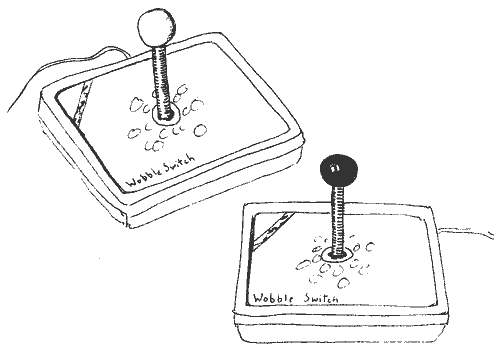
A learner is presented with two or more identical switches. Only one is actually plugged in. This arrangement is rich with teaching and learning possibilities. Obviously what you will do in practice will depend upon the nature of your student's disability, and your ambitions for her, but here are some practical examples of the use of dummy switches, selected to demonstrated the range of benefits to the teacher as well as to the learner.
1) Progressive learning - an example.
Two single 'press' switches are offered to the student. Each has a home-made yellow paper overlay stuck upon it. The working switch has a large black dot, the other a small black dot. The student has to identify the correct switch, wherever it is put, by the size of the dot. After success at this, gradually change the dot size until the difference is less marked. Later, add a third switch, also a dummy.
2) Making choices - an example.
If a learner has not yet demonstrated that she can make choices, set a switch with a black overlay, and one with a white overlay, in various positions, the white one, say, being the working switch. Watch the student's behaviour, to see if she begins deliberately to avoid the wrong switch as she reaches for the right switch. Challenge her, then, by placing the good switch in a difficult position, perhaps causing her to reach across mid-line, whilst the dummy switch is set directly beneath her best hand. When you are sure that she is capable of choosing the right switch in the majority of trials, you might go on to offer her a 'menu' at mealtimes, such that she can choose between food and drink, and tell you, by pointing, which she wants.
3) Assessment - an example.
Dummy switches can teach us a lot about the quality of vision a learner might have. Try a red switch and a yellow dummy, and, if the student is successful in selecting the correct one, replace the overlay on the dummy with one which is close in colour to that on the red switch. You might discover that eventually she will not be able to tell one from the other. Try other colours, or shapes instead of colours. (I mentioned earlier that, by changing the bulb colour in the output, you might discover some colour preference. We have one lad who will not bother with a switch system when the reward is a blue light - he appears not to see it at all.) Again, you might find that the student makes better selections without her glasses, and this will tell you something about the prescription for the correction of her vision.
Certainly, if you plan the challenges well, you will glean some useful information which might help toward the overall visual assessment of your student.